Last Trains and First Sessions: Designing a Rail-Aware Conference Day
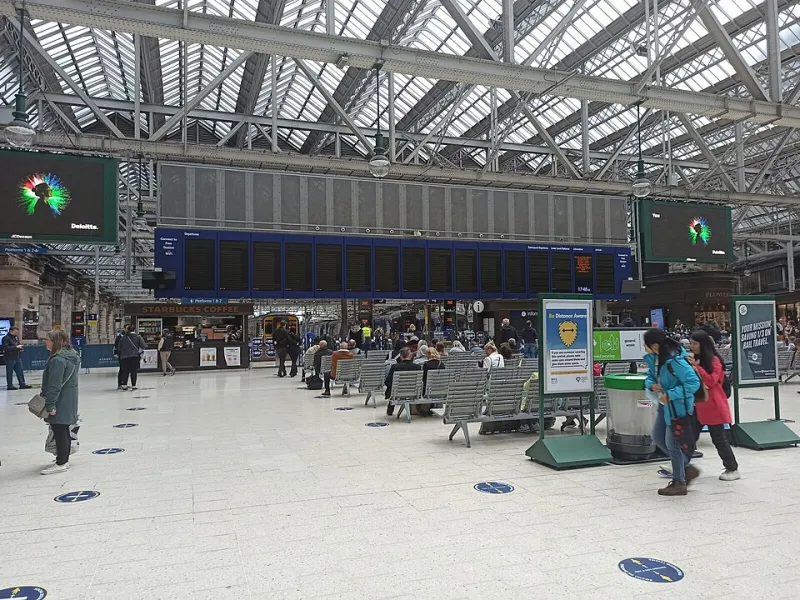
Photo: Thomas Nugent , CC BY-SA 2.0, via Wikimedia Commons
Conference programmes are often built as grids of availability: a room, a sponsor, a speaker and a clock. Rail travel enters late, usually as a line in an email about arrival times. Yet for many UK speakers the train is not a detail. It shapes whether they can accept, whether they can stay for questions and whether they will arrive calm or close to apology. A rail-aware programme treats travel as part of the schedule rather than an afterthought.
The problem is structural. A speaker travelling from another city may face a last service before the evening reception ends, a Sunday timetable with engineering work, or a strike day announced after the programme is published. The programme may place that speaker in the final slot because the morning belongs to sponsors and the afternoon to a panel. The result is a speaker watching the clock through their own session, or an organiser learning at 16:00 that the 17:30 slot has become a remote call from a station concourse.
Map the travel before fixing the grid
Start with a simple speaker travel map. For each contributor, record origin, typical journey time, whether a day return is realistic, and the last sensible departure. Do not rely on the speaker to volunteer this at the point of invitation; ask directly in the brief. A speaker coming from Leeds to London may manage a day return for a midday slot but not for a 17:30 keynote followed by a reception. A speaker from a branch line may have one useful train in each direction.
Classify slots by travel risk. Low risk: local speakers, those already staying overnight, or those with frequent services. Medium risk: day-return speakers with a comfortable but not generous margin. High risk: long-distance day returns, final-slot appearances, Sunday travel and any journey dependent on a single service. The classification does not need to be published, but it should shape the grid before invitations are confirmed.
Set a rail curfew and protect the exit
A rail curfew is the time after which no high-risk speaker should be programmed unless overnight accommodation is agreed. It will differ by event. In London it may be later than in a regional city with fewer evening services. The point is to choose it deliberately and tell speakers what it means. Publish a 'safe exit' time alongside the programme: the moment by which a speaker can leave the venue and still catch their intended service. This is not a lack of commitment to the event. It is evidence that the programme respects the people on it.
Build buffers around the curfew. A session that ends at 17:00 with a ten-minute walk to the station is not the same as one that ends at 17:00 with a twenty-minute Q&A, a chair who overruns and a venue with one exit. Put high-risk speakers earlier in the day, ideally mid-morning or immediately after lunch, when delays can still be absorbed. Avoid placing a long-distance speaker in the last slot before a reception unless they are staying overnight or the session is recorded in advance.
Design fallback plans before they are needed
Rail disruption is not an exotic scenario. Strikes, signal failures, weather and engineering work are part of the operating environment. A rail-aware programme has fallbacks that are agreed in advance. These might include a pre-recorded contribution with a live chair, a remote link tested before the day, a local reserve speaker briefed on the session, or a structured chair-led conversation using the absent speaker's questions. The fallback should be written into the run of show, not improvised at the registration desk.
Contingency also needs a communication rhythm. Confirm travel plans a week before, check service updates the day before, and give the speaker a named contact who can make a decision without hunting for the programme chair. If a speaker is delayed, the chair should know whether to fill, swap or shorten. If a session is moved, the audience should hear it from the stage rather than infer it from an empty lectern.
A sample rail-aware day
A practical pattern for a city-centre conference with a mix of local and national speakers might look like this:
- 09:30–10:10: Local keynote or speaker already in the city. Low travel risk.
- 10:25–11:05: National speaker with a day return and a mid-afternoon train. Buffer before and after.
- 11:20–12:00: Panel with at least one local chair who can hold the session if a contributor is delayed.
- 13:30–14:10: High-risk speaker after lunch, with a pre-agreed remote fallback.
- 14:25–15:05: Workshop led by a local facilitator; no dependency on a single arrival.
- 15:20–16:00: Final keynote by a speaker staying overnight, or a recorded contribution with live discussion.
- 16:00–16:20: Safe exit window published for day-return speakers.
This is not a universal template. It is a way of thinking: place the people with the least travel flexibility where the programme can absorb disruption, and place the people with the most flexibility at the edges.
Respect the programme and the people on it
A rail-aware programme is not a lower-ambition programme. It is a more honest one. It recognises that a speaker who is worried about the last train is not fully present, and that an audience can tell. It also recognises that organisers cannot control the railways, but they can control the grid, the buffers and the fallbacks.
The test is simple. Could every speaker on the programme reach their session and leave again without relying on luck? If not, the schedule needs another look. The best conference days are not only well-curated. They are buildable by the people who have to travel to them.