The Quiet Hand on the Clock: Agreeing Time Signals That Steady a UK Speaker

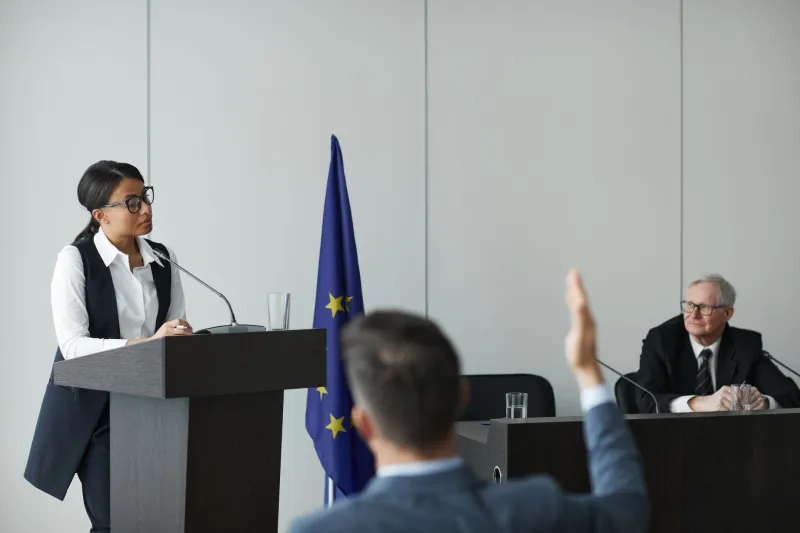
The clock in a conference room is never neutral. It sits on the lectern, hangs above the stage or glows from a tablet, and every glance at it carries a message. For a speaker, that message can be reassurance or reproach. For an organiser, it is a tool for protecting the running order. The difference lies in how the signal is designed, agreed and delivered.
In UK venues, timekeeping practice varies widely. A university auditorium may have a countdown clock linked to the AV desk; a civic hall may rely on a chair with a set of laminated cards; a converted warehouse may have no fixed sightlines at all. Each arrangement can work, but only if the speaker knows what to expect and can see or hear the cue without breaking the thread of the argument.
The Trouble With the Surprise Bell
A bell is a blunt instrument. It interrupts, and interruption is rarely neutral in its effect. A sudden chime can sound like a fire alarm, a school register or a timer in a kitchen. It pulls the audience's attention away from the speaker and towards the mechanism of control. The speaker, meanwhile, must decide whether to stop mid-sentence, acknowledge the sound or pretend not to hear it. None of those options is ideal.
Countdown clocks can be equally disruptive if they are introduced without warning. A speaker who has rehearsed without a visible timer may find the changing numbers distracting, particularly if the clock is placed to one side and requires a deliberate turn of the head. Flashing lights present similar problems, especially in rooms where stage lighting is already uneven.
The issue is not that time should go unmarked. It is that the marking should be predictable. Timekeeping works best when it behaves like a stage prop: present, purposeful and unobtrusive until it is needed.
A Signal Plan Agreed in Advance
The most effective timekeeping begins in the briefing, not in the room. Organisers should treat time signals as part of the speaker's technical requirements, alongside the microphone, the slides and the lectern. The conversation should cover four questions: what signal will be used, where it will be positioned, who will deliver it, and what happens when time runs out.
Speakers should be asked about their preferences and any access needs. A visual cue may be useless to someone with a sight impairment; an auditory cue may be difficult for someone who is hard of hearing or working in a room with poor acoustics. A combination is often best: a clock in the eyeline, a card from the chair and a quiet word at the side of the stage if necessary. The agreed plan should be recorded in the session notes and repeated at the pre-session check.
Making Time Visible Without Dominating
Placement matters. A clock should sit within the speaker's natural field of view, ideally at eye level and slightly to one side of the audience. It should not require the speaker to turn away from the room or squint into a dark corner. In venues without fixed AV, a tablet on the lectern or a large analogue clock on a side table can serve the purpose. The numbers or hands should be legible from the speaking position, not merely from the back of the room.
Where cards are used, they should be printed in a clear, high-contrast font and shown from a position the speaker can see without searching. The chair or timekeeper should be briefed on how to hold the card steady and where to stand. A card that appears at the edge of the stage for two seconds is not a cue; it is a rumour.
A Graduated Sequence
Time signals should form a sequence rather than a single alarm. A typical pattern might run as follows:
- Ten minutes remaining: a first card or a clock change, unobtrusive and early enough to allow the speaker to adjust.
- Five minutes remaining: a second cue, slightly more visible.
- Two minutes remaining: the chair moves to the front of the stage or raises a hand, signalling that the closing section should begin.
- Time: the chair stands, thanks the speaker and invites a final sentence. The microphone is not cut unless that has been agreed in advance.
The final cue deserves particular care. A speaker who is mid-argument at the appointed minute needs a moment to land the point; a chair who steps forward too abruptly can make the ending feel like an eviction. The agreed signal should distinguish between wind up and stop.
The Human Cue
However good the technology, a human being should be responsible for the final judgement. A named timekeeper or chair can see whether the speaker is approaching a natural conclusion, whether the audience is gripped or restless, and whether a thirty-second extension would serve the session better than a strict cut-off. The clock measures minutes; the chair reads the room.
That discretion should be bounded by the running order, not used as an excuse for chronic overrun. If a session is running late, the answer is usually to adjust the next changeover or shorten the question slot, not to accelerate the speaker. Timekeeping that hurries one speaker to protect the schedule often costs more in authority than it saves in minutes.
The Speaker's Part
Speakers have responsibilities too. Rehearse to time, not just to content. Know which sections can be compressed and which cannot. Agree the signals in advance and ask for a clock if none is visible from the stage. Glance at the time at transitions rather than mid-sentence, when a glance is least disruptive. A speaker who has internalised the shape of the talk will use the cues as confirmation, not correction.
After the Session
A brief debrief helps. Did the signals work? Were they seen? Did the chair and speaker agree on what happened at zero? Notes from one session can improve the next, particularly in venues that host recurring events. Over time, an organisation can build a house style for timekeeping that speakers come to trust.
The clock is a stage prop, but it is also a promise. It says that the speaker's time has been planned for, not merely limited. When signals are agreed, visible and humane, they protect the speaker's authority and the audience's attention. When they are sudden and unexplained, they turn a talk into a race against the room. The difference is not the clock itself, but the care with which it is placed.